When Do You Need a Bike Fit?
Three situations justify spending on a fit: persistent pain or numbness that doesn’t resolve with saddle/stem changes, buying a new bike (get fit before choosing size), or chasing aerodynamic gains for time trials and triathlon. If your bike feels comfortable and you’re injury-free, a fit is optional.
DIY Formulas
Static measurement
Free
Your own time
You adjust
BikeFit/LAB
2D phone video (browser)
€2.50–€5
12 s of video
You adjust
MyVeloFit
2D phone video
$35–$75
Results ~90 s after upload
You adjust
idmatch Bikelab
Foot tools + fit bike
~$300
About 1 hr
In-person fitter
Retül
3D motion capture
$245 / €250
2–2.5 hr
In-person fitter
Guru
Motorised fit bike
$300–$399
2 hr
In-person fitter
Quick Comparison
| Method | Who adjusts | Cleat advice | Cost | Best for |
|---|---|---|---|---|
| DIY Formulas | You | No | Free | A first setup |
| BikeFit/LAB | You | No (stated by BikeFit/LAB) | €2.50–€5 | The cheapest video check |
| MyVeloFit | You | No (stated by MyVeloFit) | $35–$75 | A first check or second opinion |
| idmatch Bikelab | Fitter | Yes, dedicated tools | ~$300 | Foot and cleat problems |
| Retül | Fitter | Not described by Retül | $245 / €250 | Pain, injury, or an aero position |
| Guru | Fitter | Not described | $300–$399 | Choosing a new frame |
Individual Reviews
DIY Formulas (Free)
The classic starting points are a formula and a quick check. The LeMond method sets saddle height at 0.883 × your inseam. The heel method, as Cycling UK describes it, puts your heel (not your toes) on the pedal at the bottom of the stroke and sets the saddle so your leg is completely straight.
How close do they get? Peveler and colleagues tested both on 19 trained cyclists against a target knee angle of 25–35° at the bottom of the stroke. The heel method landed inside that range 70% of the time and the 0.883 formula 65%, so the authors recommend setting the saddle by measuring the knee angle directly. Formulas also can’t account for flexibility, injury history, or riding style, and static measurements miss what happens while you pedal, such as hip rock or knee tracking.
Verdict: A free starting point that gets about two in three riders into the target knee range. Fine for a first setup or a new bike, but not a substitute for a fit if you have pain.
MyVeloFit ($35–$75)

You complete a mobility assessment, film yourself riding on a trainer, and upload the video; MyVeloFit says results arrive in about 90 seconds. It tracks your joints from the video and returns adjustments in millimetres — in Cycling Weekly’s test it lowered the saddle by 15mm. The Enthusiast plan ($35) covers one fit, road or aero position but not both; Pro ($75 a year, auto-renewing) lets you fit as many of your own bikes as you like.
How accurate is it? MyVeloFit says its results are consistent with some of the top professional fitters, and it refunds you if it can’t improve your position within 30 days. The independent checks we found each used a single rider. In Cycling Weekly’s 2023 test, a shop fitter’s software recommended almost the same changes as the app. In Granfondo Cycling’s 2024 test, MyVeloFit suggested no change to saddle height or setback, while a Retül fitter moved the saddle 3mm up and 7mm forward. We found no peer-reviewed validation.
MyVeloFit doesn’t give cleat advice, and its own FAQ points riders with some issues, such as knee tracking seen from the front, to an experienced in-person fitter.
Verdict: The video fit with the longest track record, backed by a refund guarantee. A good first check or second opinion, but there are too few independent comparisons to call it as accurate as an in-person fit.
BikeFit/LAB (€2.50–€5 per fit)
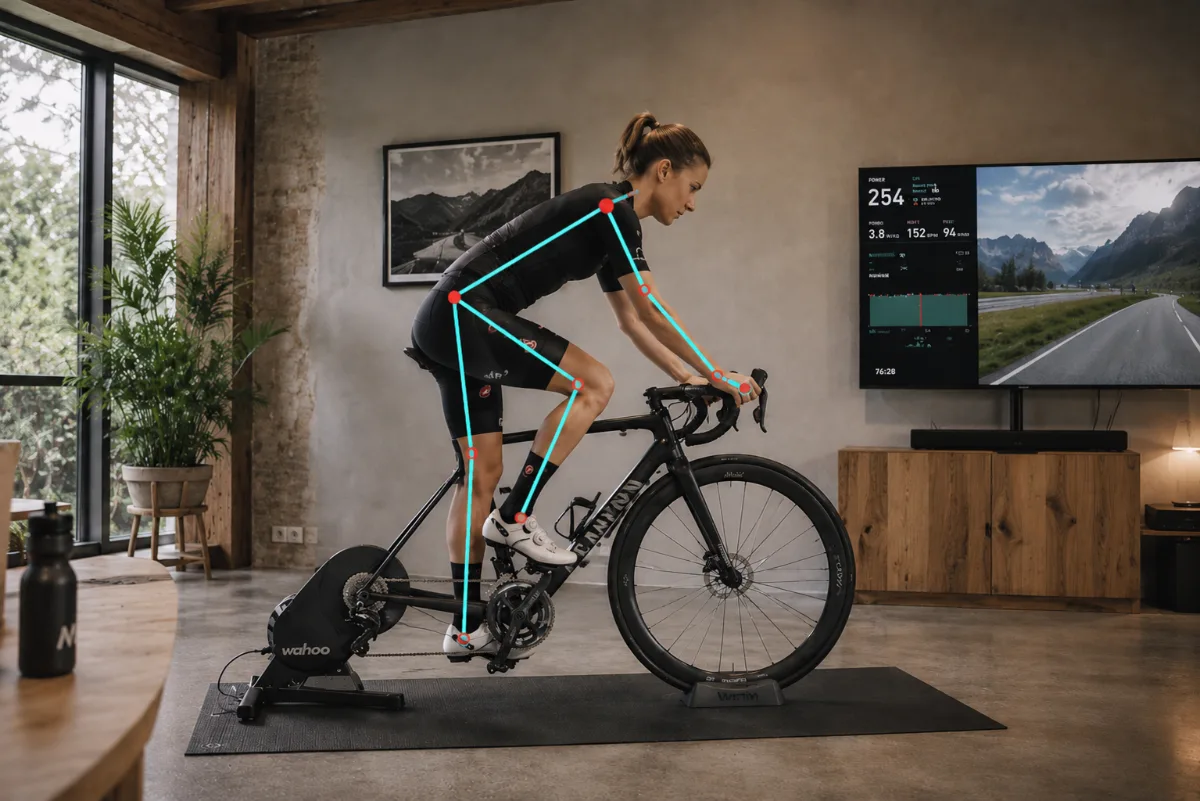
A Dutch newcomer (its website dates from mid-2026) that works in the browser. You film about 12 seconds of pedalling from the side on a trainer, and a pose-estimation model (Google’s MediaPipe) running in your browser measures knee extension at the bottom of the stroke, knee and hip angle at the top, torso and elbow angle, cadence, knee position over the pedal, and hip rock on the saddle. You enter your inseam once, and it turns the angles into millimetre adjustments for saddle height, saddle setback, and reach, delivered on screen, as a PDF, and by email. It has separate target ranges for road and gravel, MTB, city and e-bikes, and TT/triathlon.
Pricing is per fit with no subscription: €5 for one, €10 for three, or €25 for ten (€2.50 each), and credits don’t expire — the cheapest paid option in this guide. According to its privacy policy, the video stays on your device; when you generate a report, two annotated still frames are sent to its server and kept with the PDF.
The limits are those of any single-camera 2D system, and the company states them itself: no cleat assessment, no left/right asymmetry, ankle values are the least reliable, and only the knee target range comes from research. Peer-reviewed tests of the same MediaPipe model against reflective markers found errors of roughly 3–6° at the knee and hip. BikeFit/LAB hasn’t published a validation study of its own, and we found no independent reviews yet.
Verdict: The cheapest way to get a video-based position check, with clearly documented limits. Worth €5 as a first check or a second opinion — MyVeloFit has the longer track record.
idmatch Bikelab (about $300)

idmatch is a Selle Italia brand, founded in 2013, whose fitting system is offered through bike shops. Its foot tools are the most specific in this guide: the Footmeter measures the foot with a laser beam and a millimetre scale, the Tiltmeter checks how the forefoot sits under load, and the Foot Fitting kit lines up the pedal axis with the foot’s balance point. The Smart Bike (pictured) is its fitting simulator.
The session prices we found are US figures from 2021–2022: $300 at Bike Mart in Dallas, reported by D Magazine, and about $300 in The Sweet Cyclists’ review, which put the session at about an hour. We found no current published price.
Verdict: The fit to choose if your problems start at your feet — it’s the only system here that publishes dedicated cleat and forefoot tools.
Retül (about $245 / €250)

Before the fit, your fitter reviews a physical assessment of your limitations, previous injuries and pain, and riding goals. Then LED markers go on 8 anatomical points, and Retül’s Vantage motion-capture system tracks them in 3D on every pedal stroke, on your own bike or a fit bike, giving the fitter real-time data to adjust your position against. Once the position is set, the Retül Zin tool makes a digital map of your bike’s setup, and you get a report to refer back to.
Retül doesn’t publish a price or a session length. Independent reports put a session at two to two and a half hours (Granfondo Cycling; the Specialized Concept Store in the UK), and the fitters we found charge $245 (Playtri in Dallas) and a fixed €250 (the German fitter in Granfondo’s test). Retül’s fit page doesn’t describe cleat work, so ask your fitter whether it’s included.
Fits are offered at Specialized stores, such as the Specialized Concept Store in the UK, and by independent fitters such as Playtri. Granfondo’s test is a reminder that the fitter matters as much as the system: its Retül fitter and a MotionLab fitter gave the same rider different saddle changes (3mm up and 7mm forward, against no height change and 4mm forward).
Verdict: Our pick for an in-person fit: an injury-aware assessment, 3D data on every pedal stroke, and a report you keep. Worth it for persistent pain, injury history, or an aero position.
Guru ($300–$399)
Guru’s Dynamic Fit Unit is a motorised, computer-controlled fit bike: electronic motors move the saddle and aerobars while you keep pedalling, so you don’t have to stop or dismount between positions as on a mechanical fit bike. Triathlete’s 2011 write-up adds that it can mimic the fit coordinates of specific bikes, so you can feel the difference between frames before you buy.
Podium Multisport in Atlanta lists a two-hour session on its Guru 2.0 system at $399, including an interview, a flexibility and functional-strength assessment, dynamic motion capture, and digital reports with bike-fit coordinates and frame geometry. Sports Basement in California lists a Guru fit at $300.
Check availability first: Guru’s own website (gurucycling.com) returned a server error when we checked in October 2026, and its other domains are parked or for sale. Support for existing Guru systems is now sold by Kalida Technologies in Québec, and some studios, like the two above, still run Guru fits.
Verdict: Lets you feel position changes without stopping, which is most useful when you’re choosing a new frame. Check that a studio near you still offers it.
What We’d Recommend
For a first check: MyVeloFit ($35). The video fit with the longest track record and a 30-day refund guarantee. BikeFit/LAB (€5) is the cheapest alternative, but it has no independent test yet.
For pain or injury: Retül (about $245 / €250). An in-person fit that starts with an injury assessment and measures you in 3D. If the problem starts at your feet, an idmatch fitter’s cleat tools are the better match.
For a new bike: Retül, or Guru where a studio still offers it. Know your position before you choose a frame size.
Fit right, then train right
Paincave builds training plans that match your fitness level and available time. No coach fee, no guesswork.
Sources
- Makers’ own pages (read October 2026): fitlab.bike (product, pricing, methodology, and privacy pages), MyVeloFit (home page, pricing, and FAQ), idmatch (About, Footmeter, Tiltmeter, and Smart Bike pages), Retül’s Retül Fit page, and Kalida Technologies’ Guru support page.
- Independent tests: Granfondo Cycling, “Bike fitting put to the test” (April 2024), comparing MyVeloFit, a Retül fitter, and MotionLab on one rider; Simon Fellows’ MyVeloFit test for Cycling Weekly (November 2023); The Sweet Cyclists’ idmatch review (2022); D Magazine on Bike Mart’s idmatch fitting (October 2021).
- Fitters’ prices and session lengths: Playtri (Retül, $245), the Specialized Concept Store UK (Retül session length), Podium Multisport (Guru, $399), and Sports Basement (Guru, $300).
- Guru fit bike: Aaron Hersh, “Tech Support: Shape Shifter” (Triathlete, December 2011).
- Research: Peveler et al. (2005), comparison of saddle height methods in 19 trained cyclists (Journal of Exercise Physiology online); Cycling UK’s saddle height guide (heel method); Bini, Nascimento and Nibali (2023, Sport Sciences for Health), MediaPipe against reflective markers in 26 cyclists.
Guru’s availability was checked against its own domains in October 2026. We found no independent review of BikeFit/LAB. No affiliate links were used in this article.