What a Readiness Score Is Built From
All five scores share a core: heart readings plus how well you slept. Heart rate variability (HRV), the beat-to-beat variation in your heart rate, is the one input every maker names. Where they differ is what else goes in, above all whether your recent training is part of the score or tracked separately.
| Input | Apple | WHOOP | Polar | Garmin | Oura |
|---|---|---|---|---|---|
| Heart rate variability | Yes | Yes | Yes | Yes | Yes |
| Resting or sleeping heart rate | Vitals | Yes | Yes | — | Yes |
| Breathing rate | Vitals | Yes | Yes | — | — |
| Skin or body temperature | Vitals | Yes | — | — | Yes |
| Blood oxygen | Vitals | Yes | — | — | — |
| Last night’s sleep | Yes | Yes | Yes | Yes | Yes |
| Sleep history or regularity | Yes | — | — | Yes | Yes |
| Recent training load or activity | Yes | — | — | Yes | Yes |
| Daytime stress | — | — | — | Yes | — |
Apple, Garmin and Oura fold your recent activity into the score. Apple counts active calories, workout effort ratings and its Training Load; Garmin counts its acute load and the recovery time left from your last workout; Oura has two activity contributors, previous-day activity and activity balance. WHOOP and Polar don’t list training load as an input: WHOOP’s Recovery is built from HRV, resting heart rate, sleep performance and respiratory rate, with blood oxygen and skin temperature also included, while training sits in a separate Strain score. Polar’s Nightly Recharge combines an overnight nervous-system reading with a sleep reading, and training load lives in its own Training Load Pro feature.
That split matters if you already track load in training software: a score that includes load partly repeats your fitness and fatigue numbers, while a body-only score is a separate signal. Our CTL, ATL and TSB guide explains the load side.
None of the pages we read gives the full weighting. Garmin comes closest: it says the primary drivers are last night’s sleep and the recovery demands of recent activities. Polar says heart rate has the largest influence on its nervous-system reading and breathing rate the smallest.
What the Research Says About Training by HRV
Every score here uses HRV, and the research tests HRV-guided training: adjusting each day’s training load and intensity to a daily HRV reading instead of following a fixed plan. One trial and two meta-analyses test that idea.
- Cyclists: Javaloyes and colleagues (2019, International Journal of Sports Physiology and Performance) split 17 well-trained cyclists into an HRV-guided group and a traditional plan for eight weeks. The HRV-guided group improved peak power by 5.1%, power at the second ventilatory threshold by 13.9% and 40-minute time trial performance by 7.3%; the traditional group did not improve significantly. The difference between the groups was not statistically significant, though.
- VO2max: Granero-Gallegos and colleagues (2020, IJERPH) pooled six studies with 195 participants. HRV-guided training raised VO2max with a small effect (effect size 0.402) against 0.215 for predefined training, with larger gains in amateurs than in elite athletes. The authors call the quality of the evidence unclear: few studies, high or unclear risk of bias, and control programmes that varied.
- Wearables: Düking and colleagues (2021, Journal of Science and Medicine in Sport) pooled eight studies with 198 participants. HRV-guided training had a significant positive effect on submaximal physiological measures (Hedges’ g 0.296), but its effects on performance (0.079) and VO2peak (0.171) were small and not significant. It was also associated with fewer non-responders for performance.
In short, the benefits were small: HRV-guided training didn’t significantly beat a predefined plan on performance in the cycling trial or the wearables review, and in the VO2max review gains were larger for amateurs than elite athletes. These studies test the principle. They don’t tell you how well a particular maker’s composite score, with its own inputs and weighting, does the same job.
The makers add their own cautions. Apple’s support page says Readiness doesn’t account for health factors such as existing conditions or medications, shouldn’t be your only basis for deciding whether it’s safe to exercise, and is not a substitute for professional medical judgment. If you have symptoms that worry you, see a doctor whatever the score says. Garmin says its score is “not designed to predict performance,” and that a low score during a deliberate overload block likely reflects that work.
Quick Comparison
| Tracker | Form | Daily score | Battery | Price (US) | Subscription |
|---|---|---|---|---|---|
| Apple Watch Series 12 | Watch (needs an iPhone) | Readiness, 0–10 | Up to 24 h | $399 | None in Apple’s setup steps |
| WHOOP 5.0 / MG | Band (membership) | Recovery, 1–99% | 14+ days | $199/yr / $239/yr / $359/yr | Membership includes the device |
| Polar Loop | Screen-free band | Nightly Recharge, 6 levels | Up to 8 days | $199.99 | None (no monthly fees) |
| Garmin Forerunner 570 | Watch (47 mm) | Training Readiness, 1–100 | Up to 11 days | $549.99 | None; Connect+ optional |
| Oura Ring 5 | Ring | Readiness, 0–100 | 6–9 days | $399 | $5.99/mo or $69.99/yr; scores only without it |
What You Pay Over Two Years
The sticker price hides the real difference. Apple, Polar and Garmin charge once. WHOOP sells only memberships, with the device included. Oura sells the ring and an optional membership, but without the membership you see just the three daily scores (Readiness, Activity and Sleep) and not the detail behind them.
Over two years the Polar Loop is the cheapest way to a daily score by about $200. WHOOP One and the Apple Watch come out almost level, and WHOOP Life, the tier with the WHOOP MG, is the most expensive option here. In euros, the makers’ stores list the Polar Loop at €179.90 (global store), WHOOP at €199, €264 and €399 a year (Belgium), and the Oura Ring 5 at €429 or €529 plus €5.99 a month or €69.99 a year for membership (European store).
Editor’s Picks
Best for Training
Garmin Forerunner 570
$549.99 · load, HRV and stress in one score
Best Value
Polar Loop
$199.99 · no subscription
Best for iPhone Users
Apple Watch Series 12
$399 · Readiness built in
Individual Reviews
Apple Watch Series 12

Apple announced the Series 12 on 9 September 2026 and put it in stores on 18 September, from $399 in the US. Readiness gives a score from 0 to 10 with four bands: Recover (0–1), Pace Yourself (2–4), Ready (5–7) and Go For It (8–10). Apple says the algorithm was developed using data from its Apple Heart and Movement Study.
According to Apple’s support page, the score draws on today’s and recent activity (active calories, workout effort ratings and Training Load), on daytime and overnight readings from the Vitals app, and on last night’s sleep score plus your recent sleep history. Higher-than-usual HRV can push your vitals to Favorable and the score up. It updates during the day, so a workout can lower your score later that day. The Series 12 takes HRV readings as often as every five minutes, which Apple says is 24 times as often as the Series 11.
Two limits matter. Apple’s support page lists only the Series 12 and the Ultra 4 (from $799) for Readiness, and getting a score means setting up Activity, Sleep and overnight vitals and wearing the watch to sleep for at least seven nights. The battery is rated at up to 24 hours, or 38 in Low Power Mode, so overnight wear means finding a daily charging slot; Apple says 15 minutes of charging adds up to 12 hours. You also need an iPhone on iOS 27. Apple’s setup steps include no subscription.
Verdict: Training load, vitals and sleep history in one score, at no ongoing cost. For iPhone users who will charge it every day.
WHOOP 5.0 / MG
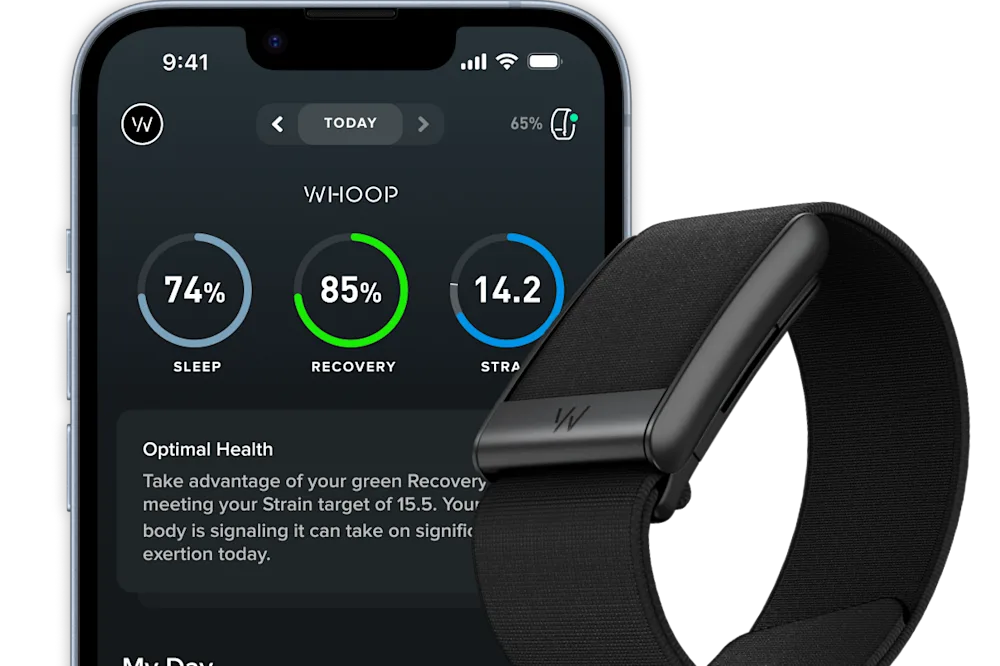
WHOOP doesn’t sell the band on its own. Its US store offers three annual memberships with the device included: One ($199 a year, WHOOP 5.0), Peak ($239, WHOOP 5.0 plus Healthspan, a health monitor and real-time stress tracking) and Life ($359, the WHOOP MG with blood pressure insights and an ECG heart screener). Recovery, Sleep and Strain scores come with every tier, and WHOOP rates the battery at 14+ days.
Recovery is a daily percentage: green from 67 to 99%, yellow from 34 to 66% and red from 1 to 33%. WHOOP builds it from HRV, resting heart rate, sleep performance (the sleep you got against the sleep you needed) and respiratory rate, and says blood oxygen and skin temperature are included as well. Training load isn’t among the inputs WHOOP lists; instead WHOOP uses your Recovery to recommend how much Strain to take on that day.
For indoor riders there is one concrete link: since 9 September 2026, Zwift reads your WHOOP Recovery and automatically adjusts its Personal Recommendations on red days, Zwift Insider reports. The downside is cost: over two years the cheapest tier costs about as much as an Apple Watch, and Life is the most expensive option in this guide.
Verdict: The widest set of named overnight body signals here, kept separate from your training load, plus a direct line into Zwift. You pay for it every year.
Polar Loop

The Loop is a screen-free band that Polar sells as “subscription-free”: $199.99 in the US and €179.90 in Europe, with no monthly fees and every feature unlocked from day one. Polar rates the battery at up to eight days. It has an optical heart rate sensor but no GPS of its own; outdoor routes come from your phone through the Polar Flow app.
Its daily score is Nightly Recharge, which Polar builds from two parts, each compared with your usual levels over the past 28 days. The ANS charge reads heart rate, HRV and breathing rate over roughly the first four hours of sleep, on a scale from −10 to +10. The sleep charge compares last night’s sleep score with your usual one. Together they give one of six statuses from very poor to very good, after three nights of measurements.
Verdict: Our value pick: the lowest two-year cost here by a wide margin, with a transparent two-part score. The fewest inputs of the five, and no screen.
Garmin Forerunner 570
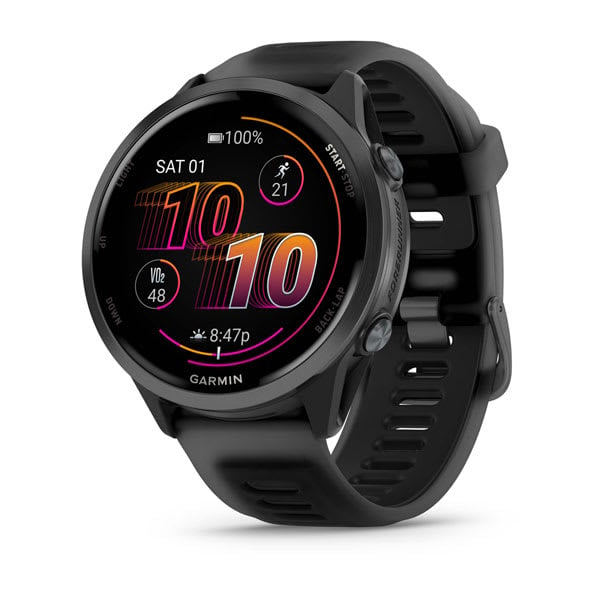
Garmin’s Training Readiness page tells buyers to check each product page for compatibility. We picked the Forerunner 570 because its product page lists the feature and Garmin sells it as a running and triathlon watch. The 47 mm version costs $549.99 on Garmin’s US store and is rated at up to 11 days in smartwatch mode.
The Forerunner 570 manual lists six factors: last night’s sleep score, recovery time, HRV status, acute load, sleep history over three nights and stress history over three days. The score runs from 1 to 100 in five levels, from Poor (1–24) to Prime (95–100), and updates through the day. HRV status compares your seven-day HRV average with your personal baseline, and each workout adds its full impact to acute load, which then wears off over ten days. It is the most training-aware score here and the only one that counts daytime stress.
There’s no subscription for it: when Garmin launched the optional Connect+ plan in March 2025, it said all existing Garmin Connect features would remain free. Garmin’s advice for block training is to check which factor pulls the score down. High load and long recovery times are expected; poor sleep or high stress may be a reason to rethink.
Verdict: Best for triathletes who want the readiness score on the same watch that records every session, with load, HRV, sleep and stress in one number. The highest device price of the five.
Oura Ring 5

Oura announced the Ring 5 on 28 May 2026 and says it is 40% smaller than the Ring 4. It costs $399 in Silver or Black and $499 in the premium finishes, and Oura rates the battery at six to nine days depending on ring size and use. The membership costs $5.99 a month or $69.99 a year in the US, and new members get the first month free.
Readiness runs from 0 to 100: Optimal at 85 and above, Good from 70 to 84, and Pay attention below 70. Oura lists nine contributors in three groups. Sleep covers last night’s sleep, sleep balance over two weeks and sleep regularity; activity covers previous-day activity and activity balance; body stress covers resting heart rate, HRV balance, body temperature and a recovery index, which counts the hours of sleep after your heart rate settled.
The catch is the membership. Without one, Oura’s support page says you see only the three daily scores plus basics such as ring battery and settings, so the contributors that explain a low Readiness sit behind the subscription.
Verdict: The best option if you won’t sleep in a watch or a band, with a detailed, activity-aware score. Budget for the membership.
What We’d Buy
Best for training: Garmin Forerunner 570. Its Training Readiness weighs acute load, recovery time, HRV status, sleep and stress, it records your sessions too, and the score costs nothing after the $549.99 purchase.
Best value: Polar Loop. At $199.99 with no subscription it is the cheapest way to a daily recovery reading, and Nightly Recharge is a body-only signal that sits alongside whatever training software you already use.
Best for iPhone users: Apple Watch Series 12. Readiness combines training load, vitals and sleep with no subscription, at $399, as long as you can charge it every day.
Track your training load with real CTL/ATL/TSB — not a proprietary black box
Paincave uses the open Banister impulse-response model. Same math regardless of which watch you wear.
Sources
- Apple (read October 2026): Newsroom, “Introducing Apple Watch Series 12 with the all-new Health Sensing System” (9 September 2026); Apple Support, “Understand your readiness score on Apple Watch” (published 6 October 2026); Apple Support, “Track your overnight and daytime vitals with Apple Watch” (published 14 September 2026); Newsroom, “Apple unveils Apple Watch Ultra 4” (9 September 2026); the Apple Watch Series 12 product page and the US Apple Store watch page.
- WHOOP (read October 2026): US and Belgian membership pages; “How Does WHOOP Recovery Work?” (WHOOP, 30 March 2022).
- Polar (read October 2026): Polar Loop product pages (US and international stores); Polar Support, “Nightly Recharge recovery measurement”.
- Garmin (read October 2026): Forerunner 570 (47 mm) product page; “Training Readiness” on Garmin Technology; Forerunner 570 Series Watch Owner’s Manual, Training Readiness section; press release “Elevate your health and fitness goals with Garmin Connect+” (27 March 2025) and the Connect+ product page.
- Oura (read October 2026): press release “ŌURA Introduces The World’s Smallest Smart Ring: Oura Ring 5” (Business Wire, 28 May 2026); Oura Ring 5 store page (European store); “Readiness Score” (updated 1 October 2026); the Membership page; Oura Member Care, “Oura Membership” (updated 16 October 2026).
- Integration: Eric Schlange, “What’s Coming Next? Read ‘This Season On Zwift’ Fall 2026 Press Release” (Zwift Insider, 9 September 2026).
- Research: Javaloyes A, Sarabia JM, Lamberts RP, Moya-Ramon M (2019), “Training Prescription Guided by Heart-Rate Variability in Cycling”, Int J Sports Physiol Perform 14(1):23–32; Granero-Gallegos A, González-Quílez A, Plews D, Carrasco-Poyatos M (2020), “HRV-Based Training for Improving VO2max in Endurance Athletes. A Systematic Review with Meta-Analysis”, Int J Environ Res Public Health 17(21):7999; Düking P, Zinner C, Trabelsi K, et al. (2021), “Monitoring and adapting endurance training on the basis of heart rate variability monitored by wearable technologies: A systematic review with meta-analysis”, J Sci Med Sport 24(11):1180–1192.
Prices are the makers’ own US and European store prices in October 2026, before any discounts (Oura’s US ring prices are from its May 2026 launch release), and they change often. No affiliate links were used in this article.