What Launched This Month
- Garmin Edge 1060 ($799.99). DC Rainmaker sums it up as the core of the Edge 1050 — screen, speaker, battery — in a smaller, lighter case, plus a microphone for voice control and voice messages and four extra buttons.
- Garmin Edge Explore 3 ($399.99) and 3 Plus ($499.99). Both have a 3-inch touchscreen and battery saver figures of up to 48 hours. Only the Plus has the speaker, microphone and voice control.
- COROS Dura 2 Solar ($499 without a mount, $549 with). A complete redesign, which COROS calls ultra-thin, with a 3.5-inch memory-in-pixel (MIP) touchscreen, a solar panel, a speaker and a microphone. COROS keeps its 120-hour battery claim. DC Rainmaker gives 3 November 2026 as the on-sale date, and the first Dura is discontinued.
The UCI Size Cap: 126 × 71 mm From 2028
In June, the UCI Management Committee met in Desenzano del Garda (2 to 4 June) and set a maximum size for bike computers of 126 × 71 mm, in force from 1 January 2028. In its press release the UCI ties the decision to the effect of on-board technology on riders’ cognitive load, and says it aims to prevent an excessive increase in the data available during races. It describes the limit as “corresponding to the largest products currently available on the market”.
The press release does not say how a computer will be measured, whether the mount counts, or which disciplines and event levels the rule covers. It only says the decisions concern equipment used by riders in competition. If you race under UCI rules, check the regulation itself before 2028.
On the makers’ published body dimensions, every computer in this guide fits. The longest is the Edge 1050 at 118.5 mm and the widest is the Karoo at 61.7 mm. Wahoo’s ELEMNT ACE, which we don’t review here, is listed on Wahoo’s support page at 125 × 71 × 20 mm and on its store page at 126 × 71 × 24 mm — at the width limit either way, and exactly the size of the cap on the store figure. COROS states in its store FAQ that the Dura 2 complies with the new size rule. Its own 117 × 58 mm figure excludes the out-front mount.
Edge 1060
107 × 58.5 mm
85% / 82% of cap
Explore 3 / 3 Plus
104.5 × 53.8 mm
83% / 76% of cap
Dura 2
117 × 58 mm (excl. mount)
93% / 82% of cap
Edge 1050
118.5 × 60.2 mm
94% / 85% of cap
Karoo
102.8 × 61.7 mm
82% / 87% of cap
ROAM 3
96 × 53 mm
76% / 75% of cap
ELEMNT ACE (ref.)
125 × 71 mm (store: 126 × 71)
99% / 100% of cap
Battery: What the Makers Claim
Battery claims are the hardest numbers to compare. Garmin quotes demanding-use and battery saver figures, COROS quotes hours by GPS mode without solar, SRAM gives 35+ hours for the Karoo with customized settings, and Wahoo gives one figure. The chart shows each with its condition.
Garmin Edge 1060
Garmin Edge Explore 3
Garmin Edge Explore 3 Plus
COROS Dura 2 Solar
Garmin Edge 1050
Hammerhead Karoo
Wahoo ELEMNT ROAM 3
Quick Comparison
| Computer | Size (mm) | Weight | Screen | Battery (maker) | Multi-band GNSS | Voice | Price (US / EU) |
|---|---|---|---|---|---|---|---|
| Garmin Edge 1060NEW | 107 × 58.5 × 16.3 | 142 g | 3.5″ LCD touchscreen, 480 × 800 | 20 h / 60 h | Yes | Mic + speaker, voice control | $799.99 / €799.99 |
| Garmin Edge Explore 3NEW | 104.5 × 53.8 × 18 | 118.8 g | 3″ LCD touchscreen, 360 × 640 | 16 h / 48 h | No (single frequency) | No | $399.99 / €399.99 |
| Garmin Edge Explore 3 PlusNEW | 104.5 × 53.8 × 18 | 121.5 g | 3″ LCD touchscreen, 360 × 640 | 14 h / 48 h | No (single frequency) | Mic + speaker, voice control | $499.99 / €499.99 |
| COROS Dura 2 SolarNEW | 117 × 58 × 17 | 99 g (no mount) | 3.5″ MIP touchscreen, 336 × 620 | 70 h / 120 h | Yes (L1 + L5) | Mic + speaker, voice control (button held) | $499–$549 / €499–€549 |
| Garmin Edge 1050 | 118.5 × 60.2 × 16.3 | 161 g | 3.5″ LCD touchscreen, 480 × 800 | 20 h / 60 h | Yes | Speaker only | $699.99 / €699.99 |
| Hammerhead Karoo | 102.8 × 61.7 × 19.9 | 118.1 g (mount 39 g) | 3.2″ touchscreen, 292 ppi | 35+ h | Yes | Not stated | $525 / €500 |
| Wahoo ELEMNT ROAM 3 | 96 × 53 × 24 | 109 g | 2.8″ TFT touchscreen, 320 × 480 | 25 h | Yes (dual-band) | Speaker (voice turn prompts) | $449.99 / €449.99 |
Prices are each maker’s own store on 26 October 2026: the US store, then Garmin’s Dutch store, the COROS and Wahoo EU stores, or SRAM’s store as shown in the Netherlands. The Dura 2’s $499 unit comes without a mount. Multi-band and voice entries are from the makers’ spec sheets; the Explore 3’s single-frequency GNSS is from the5krunner, and the Dura 2’s held-button voice control from DC Rainmaker.
Editor’s Picks
Best New Flagship
Garmin Edge 1060
$799.99 · 142 g · voice control
Best Value Flagship
Garmin Edge 1050
$699.99 · same screen and battery as the 1060
Best for Navigation
Garmin Edge Explore 3
$399.99 · 16 h / 48 h battery
Individual Reviews
Garmin Edge 1060
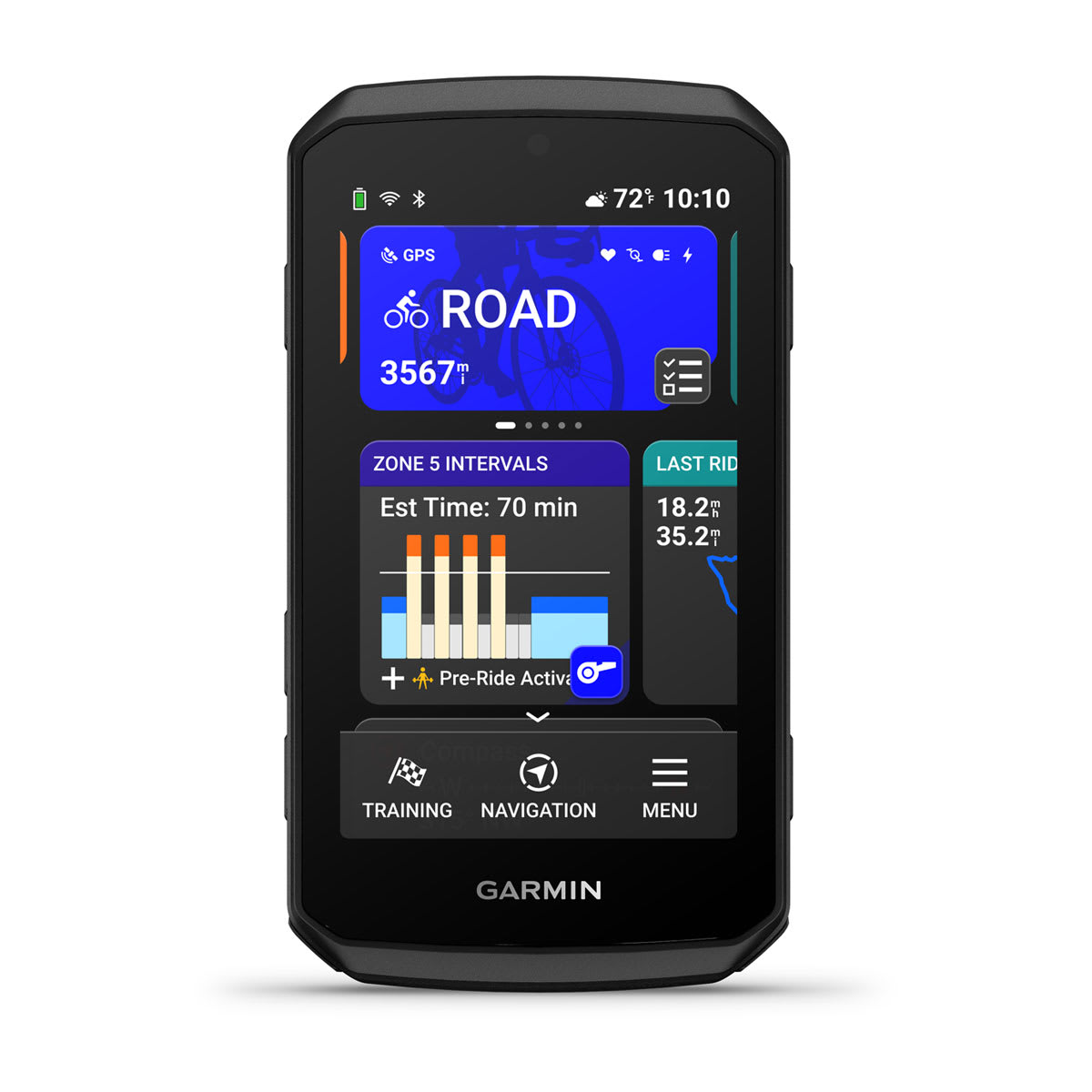
Garmin’s new flagship keeps the Edge 1050’s 3.5-inch, 480 × 800 display, 64 GB of storage, IPX7 rating and battery figures of 20 hours in demanding use and 60 in battery saver mode. The case shrinks to 107 × 58.5 × 16.3 mm from 118.5 × 60.2 × 16.3 mm, and the weight drops from 161 g to 142 g. DC Rainmaker lists the hardware changes: four added buttons (seven in all, as on the Edge 550 and 850), so every function works by button or touch; a microphone; the USB-C port moved underneath, which makes charging while riding easier; and a battery the owner can replace.
The microphone enables “OK Garmin” voice control and voice messages through the Garmin Messenger app. Garmin also lists route options based on ride time and bike type, route previews with hazards and road closures reported by other Garmin cyclists, Up Ahead points of interest such as cafés and toilets, and Free Flow Routing, which favours roads with fewer stops. DC Rainmaker adds that Strava Live Segments now work on any route, not only Strava routes, and that a number of the new software features are coming to the Edge 550, 850 and 1050.
In his hands-on, DC Rainmaker found the wake phrase was never missed at speeds up to about 50 km/h, on wet roads and on gravel, even when the request itself wasn’t always understood. A voice message runs for 30 seconds unless you tap the screen to end it, and the recipient needs the Garmin Messenger app; there is no link to the phone’s own messaging. When we checked on 26 October, his full review had not yet been published. Garmin’s US and Dutch stores both showed shipping in one to three business days.
Verdict: A smaller, lighter Edge 1050 with full button control, and voice features that held up in DC Rainmaker’s hands-on. Worth the extra $100 if you value the size, the buttons or hands-free messaging. If you don’t, the 1050 gives you the same screen and battery for less.
Garmin Edge Explore 3 and 3 Plus

Both models share a 104.5 × 53.8 × 18.0 mm case, a 3-inch 360 × 640 touchscreen and 32 GB of storage. The Explore 3 weighs 118.8 g and is rated for 16 hours in demanding use; the Plus weighs 121.5 g and is rated for 14. Both reach 48 hours in battery saver mode, which the5krunner says is double the Explore 2. Garmin lists GPS, GLONASS and Galileo but not multi-band reception, and the5krunner confirms both models are single-frequency.
Garmin’s press release lists the same navigation tools for both models as for the 1060 (route options, Up Ahead, rider-reported hazards, Free Flow Routing), plus pin drops from Google or Apple Maps, Garmin Cycling Coach plans, LiveTrack, incident detection and Varia radar support. The Plus adds a speaker and microphone for voice control, voice messages and a digital bell, and Garmin’s spec sheet gives only the Plus a Wi-Fi map manager. the5krunner’s view is that riders who want the full power-training stack should look at the Edge 850; the Explore is for maps, directions and safety alerts. DC Rainmaker expects the Explore 3 and 3 Plus to be “the hidden sweet spot for many people.”
On 26 October, Garmin’s US store showed the Explore 3 shipping in three to five weeks and the 3 Plus in five to eight weeks, and its Dutch store listed both models as orderable from 3 November.
Verdict: The best-value new unit this month for riders who mostly navigate. Pick the Plus only if you want voice control and Wi-Fi map updates, as it costs $100 more and has two hours less battery.
COROS Dura 2 Solar
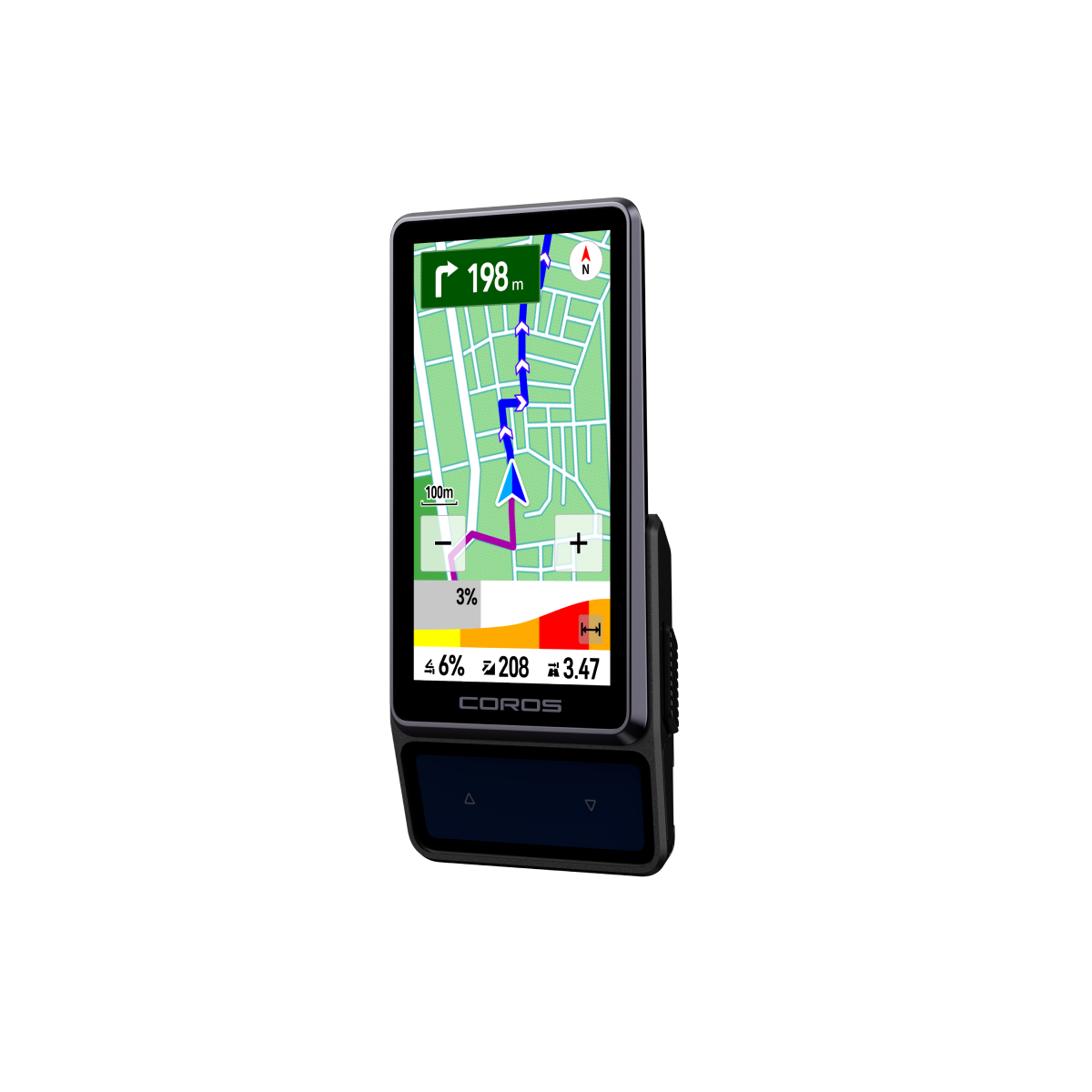
The Dura 2 is a new design. COROS lists it at 117 × 58 × 17 mm without the mount and 99 g, with a 3.5-inch, 336 × 620 MIP touchscreen, two mechanical and two haptic buttons, a speaker, a microphone and an IP67 rating. It quotes 120 hours in all-systems GPS mode and 70 hours in dual-frequency (L1 + L5) mode, both before solar charging, and says solar charging adds two hours of battery for every hour of riding. COROS’s US store lists it at $499–$549 and notes the $499 unit comes without a mount. DC Rainmaker notes that the box holds no mounting pieces at all, not even rubber mounts, and that the unit uses Garmin-style quarter-turn mounting.
DC Rainmaker’s in-depth review is mixed. On the plus side, the pressure-sensitive buttons worked with gloves in the rain, GPS tracks were clean, elevation closely matched his Garmin units, and turn prompts were correct — an improvement on the first Dura. On the minus side:
- In heavy rain the touchscreen was mostly unusable, and some settings can only be reached by swiping.
- In shade on bright days the screen was far dimmer than most other units; the Wahoo ROAM 3 and Garmin Edge x50 screens on automatic were brighter than the Dura 2 at its brightest.
- Voice control, which needs a held button, only understood him when he slowed below about 15 km/h.
- Rerouting needs a connected phone; its route choices were hit or miss, and in a simple test on final firmware it failed to reroute at all.
- An ANT+ heart-rate strap dropped out once a Bluetooth power meter was connected, still the case on final firmware, and Strava Live Segments did not trigger on any route.
COROS says the final firmware he tested is what buyers will get at launch. His rides also show how much the battery figure depends on sun:
DC Rainmaker concludes that the battery life is still excellent on most days, but that the price is not justified by the software. He suggests around $349 would have been a reasonable step up from the Dura 1.
Verdict: The longest battery claim here and a good-looking case, but the first in-depth review found rerouting and an ANT+ sensor connection still failing on the firmware COROS says buyers will get, and voice control unusable at riding speed. Wait for firmware fixes and further reviews before paying $549.
Garmin Edge 1050
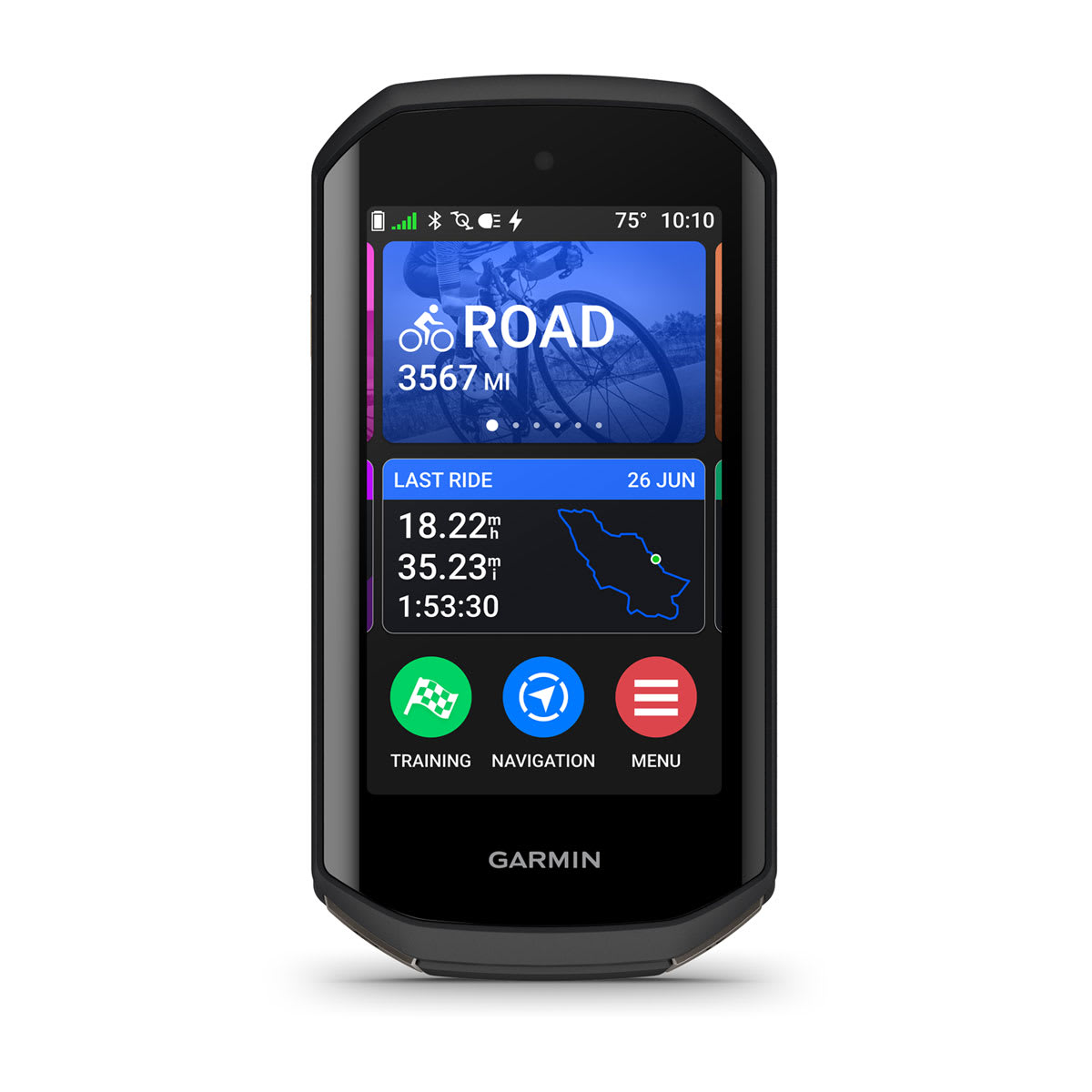
The Edge 1050 is still on sale at $699.99 in Garmin’s US store and €699.99 in its Dutch store, which now lists it under previous models. Garmin’s specs match the 1060 on the essentials: the 3.5-inch, 480 × 800 touchscreen, 20 and 60 hours of battery, 64 GB, multi-band GNSS, Wi-Fi and a speaker. It has no microphone, fewer buttons, and a larger, heavier case (118.5 × 60.2 mm, 161 g).
DC Rainmaker describes the 1050 as widely considered the best bike computer on the market, and says the 1060 is built on its core hardware. He also reports that a number of the 1060’s software features are coming to the 1050, so the gap between the two is mostly hardware: size, buttons and the microphone.
Verdict: The value pick among flagships while Garmin still sells it: the same screen and battery as the 1060 for $100 less.
Hammerhead Karoo

Hammerhead now sells its current computer simply as Karoo; our main guide lists it as the Karoo 3. Hammerhead’s spec sheet gives 102.8 × 61.7 × 19.9 mm and 118.1 g, plus 39 g for the handlebar mount. The 3.2-inch Gorilla Glass touchscreen has 292 pixels per inch, and the unit has 64 GB of storage, 4 GB of RAM, multi-band GNSS and an IP67 rating. SRAM’s store lists physical buttons alongside the touchscreen, automatic rerouting, single sign-on and automatic sensor pairing with SRAM AXS, and a link to RockShox Flight Attendant suspension. The box includes a 31.8 mm mount and a quarter-turn adapter.
SRAM quotes 35+ hours of battery life with customized ride settings, but gives no standard-use figure, so the Karoo can’t be placed directly against Garmin’s numbers. It costs $525 in SRAM’s US store and €500 (tax included) in SRAM’s store as shown in the Netherlands. We read no new independent test for this guide, so this entry rests on the maker’s specifications.
Its 292 ppi is the highest pixel density in this guide: worked out from Garmin’s published 480 × 800 resolution, the 3.5-inch Edge 1060 has about 267 ppi.
Verdict: The natural choice for riders on SRAM AXS, with the sharpest screen here. If battery life matters, check independent tests first, because the maker gives no standard-use figure.
Wahoo ELEMNT ROAM 3

The ROAM 3 is the smallest unit here in length and width at 96 × 53 × 24 mm, and weighs 109 g. Wahoo lists a 2.8-inch, 320 × 480 TFT touchscreen, up to 25 hours of battery, 64 GB of storage with 2 GB of RAM, dual-band GPS (GPS, GLONASS, BeiDou, Galileo and QZSS), Wi-Fi, a speaker for voice turn-by-turn directions, and an IPX7 rating. Navigation includes on-device routing and automatic rerouting back to a loaded route, and an out-front mount comes in the box.
At $449.99 / €449.99 it is the cheapest computer here with dual-band GPS. In his Dura 2 review, DC Rainmaker found the ROAM 3 and Edge x50 screens brighter on their automatic setting than the Dura 2 at full brightness, though he adds that the brighter screens use more battery. This entry otherwise rests on Wahoo’s specifications.
Verdict: A compact, mid-priced option with dual-band GPS and rerouting. Its smaller screen and 25-hour figure are the trade-offs against the Garmin flagships.
Which One Should You Buy?
- Newest Garmin, with voice or messaging: Edge 1060.
- A Garmin flagship for less: Edge 1050, while it is still sold.
- Mostly route-following, no power-training tools: Edge Explore 3; the Plus only for voice control and Wi-Fi maps.
- SRAM AXS groupset: Karoo.
- Battery life above all: the Dura 2 has the biggest claim, but wait until the first review’s problems are fixed.
- UCI racing: every unit here is inside the 2028 cap on the makers’ dimensions, but how the UCI will measure is not stated.
Your Computer Records the Data. Paincave Makes It Useful.
Connect your Strava account and Paincave automatically tracks your FTP, calculates training load, monitors fitness and fatigue, and builds structured plans — no matter which cycling computer you ride with.
Sources
- Makers’ product pages and stores (read 26 October 2026): Garmin US store and spec pages for the Edge 1060, Edge 1050, Edge Explore 3 and Edge Explore 3 Plus; Garmin Netherlands store (EU prices and availability); COROS Dura 2 Solar overview, specs and buy pages (US and EU stores); SRAM store, Hammerhead Karoo (US and EU); Hammerhead support, “Karoo – Hardware Specifications”; Wahoo EU store, ELEMNT ROAM 3 (including its ELEMNT ACE comparison); Wahoo support, “ELEMNT ROAM 3 (2025) Product Information” and “ELEMNT ACE (2024) Product Information”.
- Press releases: Garmin, “New Garmin Edge 1060 cycling computer gives cyclists hands-free voice control” (20 October 2026); Garmin, “Ride with more confidence with Edge Explore 3 cycling computers from Garmin” (20 October 2026); COROS, “COROS Enters the GPS Computer Market with a Vision to Simplify the Cycling Experience” (first Dura, 17 June 2024).
- Rules: UCI press release on the Management Committee meeting of 2–4 June 2026 in Desenzano del Garda (computer size limit from 1 January 2028); Kit Nicholson, Escape Collective, “No more front pockets and bike computer size limit among UCI rule revisions” (7 June 2026).
- Independent coverage: DC Rainmaker, “Garmin Edge 1060 Cycling GPS Hands-On: Everything You Need to Know!” (20 October 2026); DC Rainmaker, “COROS Dura 2 Solar In-Depth Review: The Good, the Bad, and The Ugly” (22 October 2026); the5krunner, “Garmin Edge Explore 3 Plus adds voice control at £429.99” (21 October 2026).
Prices are the makers’ own store prices on 26 October 2026 and change often. Hands-on findings are the named reviewers’. No affiliate links were used in this article.